Understand the difference between corporate training and employee development and learn how businesses can use both to improve performance and retention.
Understanding Corporate Training
Corporate training is a structured, short-term intervention designed to help an employee perform their current role better. It is task-oriented and outcome-specific. A new hire needs to know how to use the company's CRM software, a sales executive needs to learn a revised pricing model, or a factory worker needs to be certified on updated safety protocols. In every case, the goal is immediate: close a skill gap that is affecting present-day performance. Because it is tied to a specific job function, corporate training is usually time-bound. It has a start date, an end date, and a measurable outcome, such as a certification, a quiz score, or a demonstrated competency. Organisations often run this kind of training in cohorts, using instructor-led sessions, e-learning modules, or on-the-job coaching, depending on the complexity of the skill being taught.
What Corporate Training Typically Covers
• Onboarding and induction for new employees • Compliance and regulatory certifications • Technical and software skills specific to a role • Sales, negotiation, or customer service techniques • Health, safety, and workplace policy updates
Understanding Employee Development
Employee development takes a wider view. Instead of asking how someone can do their current job better today, it asks how that person can grow across their career. It is less about a single skill and more about building capability, judgement, and readiness for responsibilities the employee does not yet hold. Development is typically ongoing rather than limited to a specific training period, and it often unfolds over months or years rather than days. This is why development programmes rarely look like a classroom session. They tend to involve mentoring relationships, exposure to cross-functional projects, leadership coaching, higher education support, or planned job rotations. The employee, their manager, and the organisation share ownership of the process, and progress is judged by career trajectory rather than a test score.
Common Employee Development Activities
• One-on-one mentoring and coaching relationships • Structured career pathing and succession planning • Stretch assignments outside the employee's usual scope • Support for external certifications or higher education • Cross-departmental exposure and job shadowing
Corporate Training vs Employee Development: The Core Differences
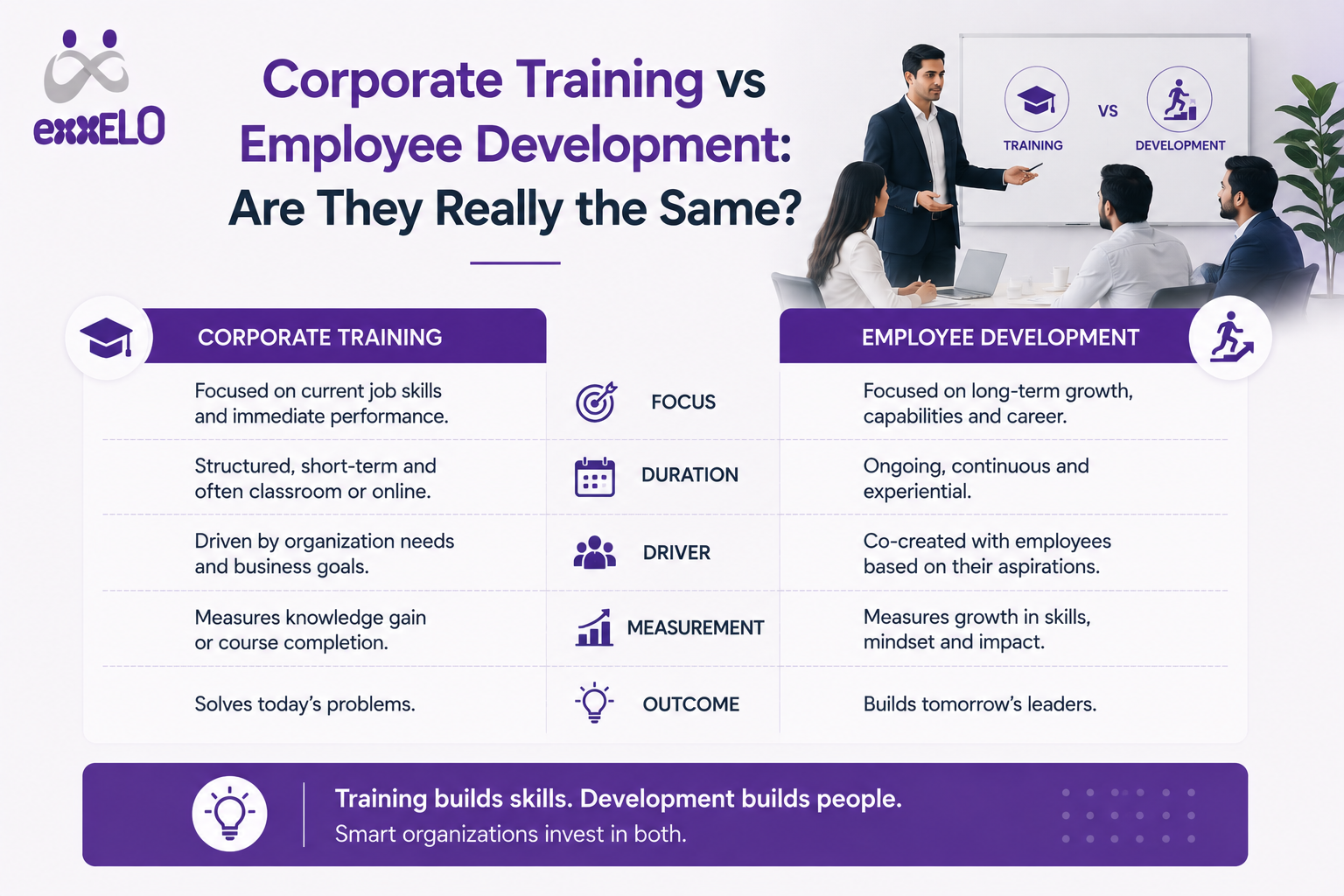
Once you place the two side by side, the differences become clearer. The table below summarises how they diverge across the factors that matter most to HR and business leaders.
Primary Objective Corporate Training: Improve performance in the employee’s current role. Employee Development: Prepare employees for future roles and responsibilities. Time Horizon Corporate Training: Short-term, often completed within days or weeks. Employee Development: Long-term, typically spanning months or years. Ownership Corporate Training: Primarily driven by the organisation. Employee Development: Shared between the employee, manager, and organisation. Typical Format Corporate Training: Instructor-led sessions, e-learning, and certifications. Employee Development: Mentoring, coaching, stretch assignments, and job rotation. How Progress Is Measured Corporate Training: Test scores, completion rates, and task accuracy. Employee Development: Promotions, retention, and readiness for larger roles. Outcome for the Business Corporate Training: Immediate competency improvement and fewer errors. Employee Development: Stronger leadership pipeline and lower employee attrition.
Not sure whether your organisation needs training, employee development, or both? Talk to Exxelo about building a people strategy aligned with your business goals.
Talk to Exxelo