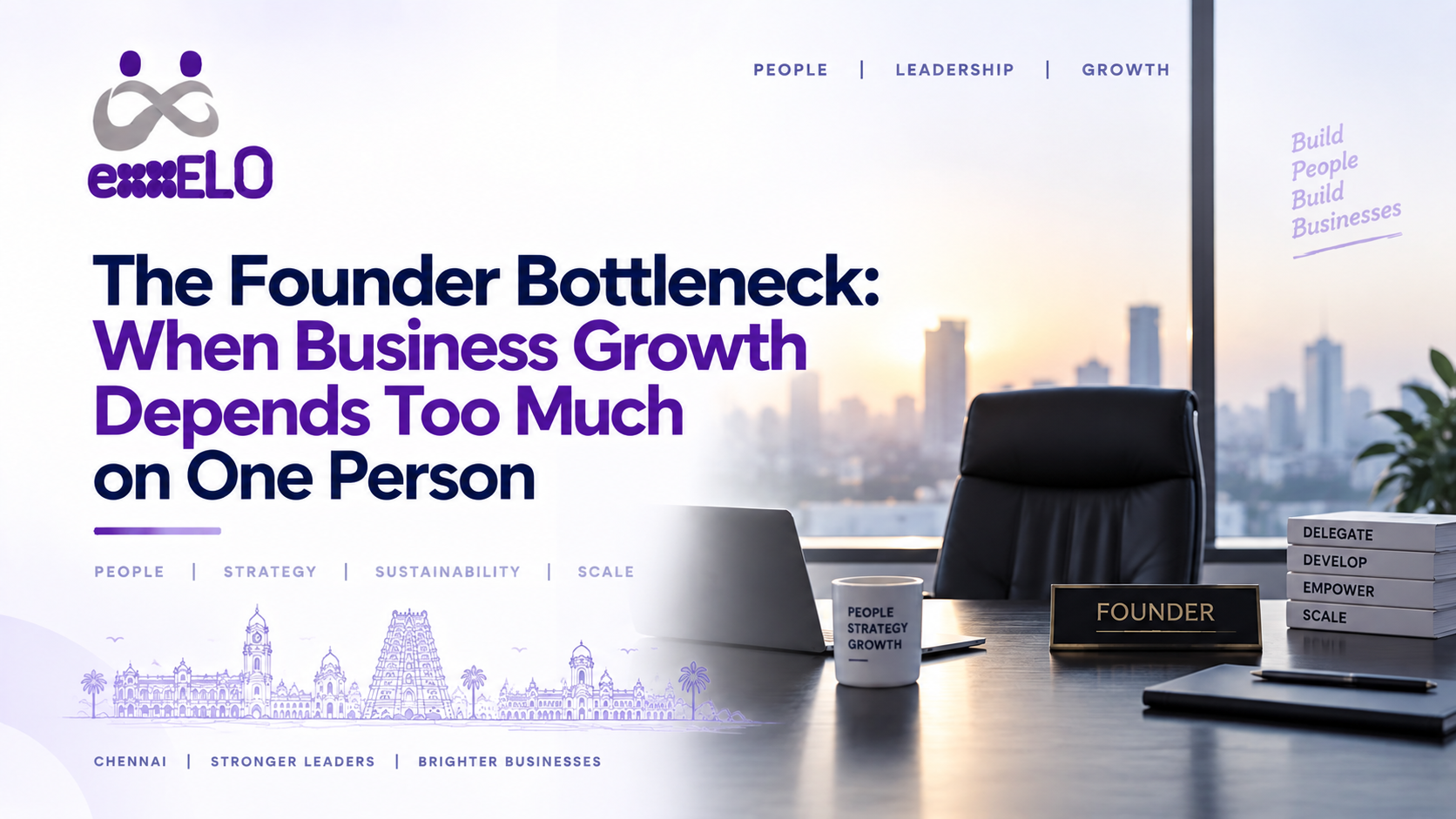
Every growing business reaches a point where the founder's hands-on involvement stops being an advantage and starts holding the company back. In the early days, doing everything yourself is normal, even necessary. But as the team, customers, and operations expand, the same instincts that built the business can quietly turn into its biggest constraint. This pattern has a name: the founder bottleneck. Recognising it early, and learning how to loosen the founder's grip without losing quality or culture, is one of the most valuable skills a business owner can build. Structured business coaching in Chennai often begins exactly here, helping owners see the pattern before it turns into a crisis.
What Is a Founder Bottleneck?
A founder bottleneck occurs when too many decisions, approvals, relationships, and pieces of institutional knowledge stay concentrated in one individual. On paper, the business may have a full team, a website, an office, and a client list. In practice, almost nothing moves forward without the owner's direct input. Emails wait for a reply. Proposals wait for a signature. Even small operational choices get escalated upward because no one else has been given the authority, or the confidence, to make the call. The concept of founder dependency appears across different types of businesses because the underlying pattern can repeat across industries, from manufacturing units to professional services firms to fast-growing startups. What changes is the scale at which it appears. A five-person studio might hit this wall relatively early, while a larger company may encounter it at a much higher level of revenue. The underlying mechanism, however, stays the same: growth outpaces the founder's personal bandwidth.
How This Differs From Normal Founder Involvement
Founder involvement and founder dependency are not the same thing. A founder who reviews major strategic decisions, sets direction, and stays close to key clients is simply leading. A founder who must personally approve routine tasks, resolve every internal disagreement, and be present for the business to function at all has become a significant point of operational dependency. The difference lies in whether the company can absorb the founder's absence for a week, a month, or a quarter without operations grinding to a halt.
Warning Signs Your Company Has Outgrown You
The signals rarely announce themselves loudly. They show up as small frictions that, over months, add up to a structural problem.
Decision-Making Signals
● Staff routinely wait for the owner's approval before acting, even on matters within their own job description. ● Strategic priorities exist mainly in the founder's head rather than in a written plan the team can reference. ● Client relationships are personally managed by the founder, with little visibility for anyone else on the team.
Team and Culture Signals
● Employees may become frustrated or disengaged when they feel they cannot grow into real ownership of their work. ● Managers pass problems upward instead of solving them, because that has always been the expected pattern. ● New hires may take longer to become productive when important knowledge is not documented or easily accessible.
Financial and Growth Signals
● Business growth becomes increasingly dependent on the founder working longer hours rather than on the team executing independently. ● The business experiences cycles of rapid progress followed by stalls whenever the founder is stretched thin. ● Investors, partners, or potential buyers raise concerns about how much the company relies on one person.
Why the Bottleneck Forms in the First Place
Founder dependency is rarely intentional. It usually grows out of habits that once served the business well and were never revisited.
Trust Gaps and Delegation Habits
Many owners delegate tasks but not authority. A manager may be told to run a department, yet every meaningful decision still needs sign-off. This half-measure feels safer in the short term, but it teaches the team not to think for themselves. Over time, capable people stop offering judgement because their judgement was never actually used.
Missing Systems and Documentation
When processes exist only as tribal knowledge, the founder becomes the default reference point for how things are done. Standard operating procedures, decision checklists, and role clarity remove this dependency, but building them takes deliberate time that busy owners often postpone.
Identity Tied to the Business
For many entrepreneurs, the company is a personal creation, not just an asset. Letting go of daily control can feel like losing part of that identity, even when the business would benefit from more distributed leadership. This emotional attachment is understandable, and it is also one of the hardest barriers to work through without outside perspective.
The Real Cost of Staying the Bottleneck
The cost of founder dependency rarely appears as a single line item on a profit and loss statement, which is part of why it goes unaddressed for so long. Instead, it shows up indirectly, in missed opportunities, slower client response times, and a leadership team that never quite reaches its full potential. The longer the pattern continues, the more expensive it becomes to unwind, since habits and expectations harden across the whole organisation.
Growth Capped by Personal Capacity
A business that only expands when the owner works harder has a ceiling built into its design. There are only so many hours, meetings, and decisions one person can handle before quality slips or momentum stalls.
Lower Valuation in the Eyes of Buyers
Investors and potential acquirers may consider founder dependency an operational risk when evaluating a business. A company that cannot run smoothly without its owner for a few weeks can be viewed as fragile, regardless of how strong its revenue looks on paper. Reducing this reliance can strengthen the business's long-term resilience and may make it more attractive to potential buyers or investors.
Burnout That Affects the Whole Team
When one person carries a large share of an organisation's operational responsibility, sustained pressure and burnout risk can increase. That fatigue rarely stays contained. Decision quality can drop, response times can slow, and the stress often filters down to the wider team, affecting morale even when nobody names the actual cause.
How to Loosen the Founder's Grip
None of this requires the founder to disappear from the business overnight. The aim is a gradual, deliberate shift from being personally responsible for outcomes to being responsible for the structure that produces those outcomes. That shift usually happens through a combination of clearer decision rights, better documentation, and consistent investment in the people who will eventually carry more of the operational load.
Build Clear Decision Frameworks
Not every choice needs the founder's input. Categorising decisions by risk and reversibility helps teams understand which calls they can make independently and which genuinely require escalation. This can help reduce the number of routine decisions that need to be escalated to the founder.
Put Processes in Writing
Documenting how key tasks are done, from onboarding a client to closing monthly accounts, converts knowledge that lives in one person's head into a resource the whole organisation can use. It can also make onboarding and training more consistent for new employees.
Develop a Second Layer of Leadership
Sustainable growth depends on managers and team leads who can make sound judgement calls without constant supervision. Investing in structured leadership development programs across India can help founder-led businesses build this second layer deliberately rather than leaving it to develop by accident.
Start With One Function, Not Everything at Once
Trying to remove dependency across sales, operations, and finance simultaneously usually overwhelms both the founder and the team. Picking one function, transferring real ownership there, and measuring how it performs without direct involvement builds confidence before scaling the approach further.
Where Outside Guidance Helps
Founders can sometimes find it difficult to see these patterns objectively because the habits causing the bottleneck are frequently the same habits that made the company successful in its early years. This is where an experienced business consultant in Chennai can offer an outside view, mapping where decisions actually get stuck and designing a practical plan to redistribute them. The goal is not to remove the founder from the business, but to reposition them from being the engine of every task to being the architect of a system that runs well without constant intervention.
Frequently Asked Questions
What is the difference between a founder bottleneck and a founder being hands-on? Being hands-on means the founder stays informed and involved in important matters. A bottleneck means the business genuinely cannot function without the founder's direct approval, even for routine tasks. At what stage of growth does the founder bottleneck usually appear? It varies significantly by business. The pattern can emerge when a growing team, increasing customer activity, or expanding operations make it difficult for the founder to personally oversee every client, task, and decision. Can a founder bottleneck be fixed without hiring a large management team? Yes. Fixing it depends more on redesigning decision rights, documenting processes, and building trust in existing staff than on hiring at scale. Founder-led companies can often reduce the problem by improving decision rights, documenting processes, and developing existing employees before significantly expanding headcount. How does founder dependency affect the sale value of a business? Buyers and investors may view significant founder dependency as an operational risk, particularly when the business cannot operate effectively without the founder. Where can a founder in Chennai get structured help with this problem? Working with a firm that specialises in business coaching, consulting, and leadership development can help founders diagnose exactly where dependency has formed and build a step-by-step plan to reduce it.
Key Takeaway
A business that depends heavily on its founder to keep things moving can struggle to develop the resilience and independence needed for sustainable growth. Spotting the founder bottleneck early, and taking deliberate steps to build systems, delegate authority, and develop leaders, allows a company to grow beyond the limits of one person's time and energy. If you recognise these patterns in your own business, it may be worth having a structured conversation about where the gaps sit and how to close them. You can contact us to discuss a practical, tailored approach for your organisation.
Is your business too dependent on you? Talk to Exxelo about identifying founder bottlenecks and building the systems, leadership, and decision frameworks needed for sustainable growth.
Talk to Exxelo