Picture a gym membership you scan every single day without ever lifting a weight. Your attendance record looks perfect, but nothing about your strength has changed. Corporate learning has operated the same way for decades. Employees sit through a session, sign the completion sheet, and the organisation quietly assumes the training worked. In reality, attendance says almost nothing about whether anyone changed how they actually do their job. Companies exploring modern Corporate Training in Chennai programs are increasingly rejecting this old assumption in favour of a simple but overdue idea: training should be judged by what people do differently afterward, not by who showed up. This shift is not simply a preference among learning and development teams. It reflects a genuine change in how organisations think about the return on their training spend, especially as budgets tighten and leadership expects proof that learning translates into performance. Quick answer: Behaviour-based training measurement means tracking specific, observable on-the-job changes, such as fewer errors, faster resolution times, or improved sales conversations, before and after a programme, rather than simply counting who attended or completed a course.
The Problem with Attendance as a Success Metric
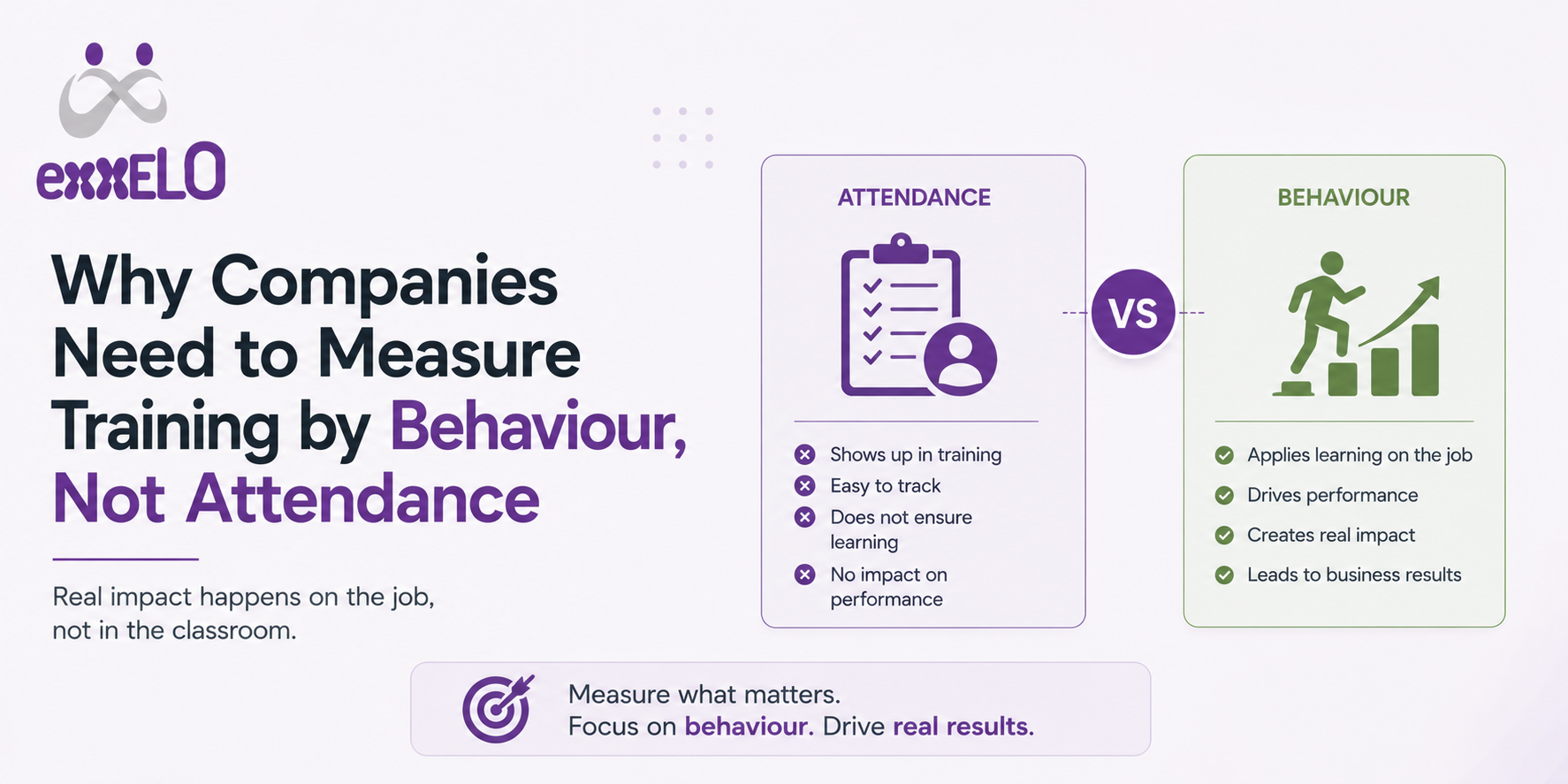
Attendance is easy to track, which is exactly why so many organisations have relied on it for so long. A completion percentage fits neatly into a dashboard and gives HR something concrete to report to leadership. The trouble is that it measures presence, not impact. An employee can sit through an entire workshop, nod along, and return to their desk without changing a single habit. Recent industry benchmarking backs this up. Learning and development leaders themselves admit that heavy workloads leave very little room for employees to properly absorb and apply what they learn, even when they technically complete a course. When time is tight, employees often go through the motions of a session without genuinely engaging with the material. That means the completion certificate becomes a record of presence rather than a record of learning.
What Behaviour-Based Measurement Actually Looks Like
Measuring behaviour instead of attendance means tracking what an employee does differently on the job after a training session, not simply whether they showed up for it. This requires a different mindset from the outset of the programme design process, since the organisation has to define observable behaviours before training even begins, rather than deciding after the fact whether it worked. Setting a Baseline Before Training Starts Behaviour-based measurement starts before a single session takes place. Establishing a clear baseline, whether that is current error rates, average call resolution time, sales conversion figures, or manager observation scores, gives an organisation something concrete to compare against later. Without a baseline, any claim about improvement is guesswork dressed up as data. Observing Change on the Job The most credible evidence of behaviour change comes from watching what happens after training, not from a survey handed out at the end of a session. Manager observation, peer feedback, and 360-degree reviews all provide direct evidence of whether a new skill actually shows up in daily work. Indirect signals matter too, such as a drop in support tickets after a customer service programme or fewer procedural errors following a compliance refresher. Giving Change Enough Time to Appear Behaviour change does not happen overnight, and measuring it too early or too late can produce misleading results. Evaluation frameworks built around this level typically call for observation to begin within a few weeks of training completion, rather than waiting a full quarter, since waiting too long makes it harder to connect any change back to the original session with confidence.
Why the Kirkpatrick Model Still Matters in 2026
The Kirkpatrick Model, first introduced in the late 1950s, remains the most widely used framework for evaluating whether training actually works. It breaks evaluation into four levels: reaction, learning, behaviour, and results. Most organisations measure the first two levels easily, since a post-session survey captures reaction and a short quiz captures learning. Behaviour, the third level, is where most companies struggle, largely because it requires ongoing observation rather than a single data point collected right after the session ends. The model itself has continued to evolve. A 2026 expansion of the framework added explicit attention to the performance environment, recognising that systems, culture, and workplace conditions all influence whether a new skill actually transfers into daily behaviour. In other words, even well-designed training can fail to change behaviour if the surrounding work environment does not support or reward the new approach. This update reinforces a point many learning leaders already suspected: training does not happen in isolation from the rest of the organisation.
Behaviour Measurement at a Glance
The table below summarises how each level of a behaviour-first evaluation approach fits together, from initial reaction to measurable business results. 1. Reaction What to measure: Relevance and engagement How to measure: Post-session survey When to measure: Immediately after training 2. Learning What to measure: Knowledge or skill gained How to measure: Short quiz or assessment When to measure: At the end of the session 3. Behaviour What to measure: On-the-job application How to measure: Manager observation and 360-degree feedback When to measure: After 2 to 4 weeks, then at 30, 60, and 90 days 4. Results What to measure: Business outcomes How to measure: KPI tracking against the baseline When to measure: One quarter or more after training
According to the TalentLMS 2026 L&D Benchmark Report, organisations that track a balanced mix of these levels, rather than attendance alone, are better positioned to prove training value to leadership.
Connecting Behaviour to Business Results
Behaviour change matters most when it eventually shows up in measurable business outcomes. This is the fourth level of the Kirkpatrick framework, and it is what ultimately convinces executive stakeholders that a training investment was worthwhile. Reduced safety incidents after a workplace safety module, improved customer satisfaction scores following a communication skills course, or faster onboarding after a revised orientation programme are all examples of behaviour change translating into a result leadership actually cares about. Connecting training to results is genuinely difficult, since many factors influence business performance at the same time. A sales increase after a training programme could reflect better selling skills, a stronger market, or a new product launch, and untangling those variables takes discipline. This is exactly why the earlier steps matter so much. Without solid behaviour-level evidence, any claim about business impact is built on a shaky foundation.
The Role of Managers in Reinforcing New Behaviour
No training programme produces lasting behaviour change on its own. Managers play a decisive role in whether a new skill sticks or quietly fades within a few weeks. A manager who asks an employee to apply a specific technique shortly after a session and follows up to see how it went dramatically increases the odds that the behaviour becomes a habit rather than a one-time exercise. This puts pressure on organisations to think carefully about who they place into management roles in the first place, since a manager who does not reinforce training defeats the purpose of the investment before it even has a chance to work. Businesses developing their leadership pipeline often look toward a specialised Recruitment Consultancy in Chennai to help identify candidates who show the coaching instincts needed to reinforce new skills, not just the technical experience to perform the role itself.
Common Mistakes Companies Make When Measuring Training
One frequent mistake is trying to measure everything at once. Behaviour-based evaluation works best when an organisation focuses on a small, clearly defined set of metrics tied to a specific business priority, rather than attempting to track every possible indicator across every department. A scattered approach produces noise, not insight. Another common error is treating measurement as a one-way audit rather than a development loop. When behaviour data is only used to judge whether employees passed or failed, it creates defensiveness rather than genuine improvement. The most effective programmes use coaching conversations built around the same data, turning measurement into an ongoing dialogue between manager and employee rather than a report card filed away and forgotten.
Building a Behaviour-First Training Strategy
Shifting an organisation away from attendance tracking requires more than a new spreadsheet. It requires designing programmes backward from the desired result, defining the specific behaviours needed to reach that result, and only then building the content and delivery format around those behaviours. This is a more disciplined process than simply scheduling a workshop and hoping the content resonates. Many companies find it easier to make this shift with outside support, particularly if they do not yet have a dedicated learning and development function capable of designing baseline measurement, observation checkpoints, and manager reinforcement into a single coherent programme. Structured training and development programmes built around defined behavioural outcomes give leadership a much clearer picture of return on investment than a simple attendance report ever could, because every stage of the programme is tied to an observable change in how employees perform their work.
What Leadership Should Ask Before Approving the Next Programme
Before signing off on the next round of corporate training, leadership teams should ask a few pointed questions. What specific behaviour is this programme meant to change? How will that change be observed, and by whom? What baseline exists to compare against once the programme concludes? If a proposal cannot answer these questions clearly, it is likely still built around the old attendance model, regardless of how modern the delivery format looks on paper. Asking these questions early also shapes vendor and facilitator selection. A training provider who cannot describe how they will help measure behaviour change, beyond a satisfaction survey at the end of the session, is unlikely to deliver a programme that moves the needle on real performance.
Making the Shift Sustainable Over Time
A single behaviour-focused pilot programme is a good starting point, but sustainable change requires the same discipline applied consistently across every future training initiative. This means building baseline setting, observation checkpoints, and manager reinforcement into the standard process for approving any new programme, rather than treating it as a special exercise reserved for high-visibility projects. Over time, this consistency builds a body of internal evidence about what actually works within a specific organisation. Instead of relying on generic industry benchmarks, leadership gains a clear, homegrown picture of which training formats reliably change behaviour for their own teams, which makes every future investment decision easier to justify.
Key Takeaway
Attendance was never a meaningful proxy for learning. It was simply the easiest thing to count. As training budgets face more scrutiny and leadership expects clearer proof of return, organisations that continue to report completion percentages as their primary success metric will find it increasingly difficult to justify continued investment. Measuring behaviour instead, supported by clear baselines, manager reinforcement, and a genuine connection to business results, gives companies a far more honest picture of whether their training works. If your organisation is ready to move beyond completion certificates and build a training strategy centred on real behaviour change, contact us to discuss an approach designed around your specific performance goals.
Ready to make your training more measurable and outcome-focused? Talk to Exxelo about building a training and development programme centred on real behaviour change.
Talk to Exxelo